
Dividend yield is the annual dividend per share divided by the share price, expressed as a percentage. It shows what a shareholder earns in income relative to what the stock costs. Because price sits in the denominator, yield rises when the price falls, which is why unusually high yields are so often warnings.
The mechanism that misleads people
A yield can rise for two entirely different reasons. Management raises the dividend, which is good. Or the share price falls, which usually is not. The ratio looks the same either way.
Worked example
A company pays $2.00 a share. The stock trades at $50, then falls to $25 on a weak outlook.
Before: $2.00 ÷ $50 = 4.0%
After: $2.00 ÷ $25 = 8.0%
The yield doubled because the market halved its view of the company. Nothing improved. Screening for high yield is, quite reliably, screening for companies the market has doubts about.
What the market is usually telling you
A yield far above sector peers is a forecast, not a gift. The market is pricing in a cut. It is sometimes wrong, which is where the opportunity lives, but the base rate favours the market. Before treating a high yield as income, work out what the price is anticipating and whether you disagree for a reason you can name.
The checks that matter are coverage rather than level: the payout ratio against earnings, and more importantly against free cash flow, plus interest coverage on the balance sheet. Five checks catch most cuts before they are announced, and none of them is the yield itself.
Yield is only part of the return
Total return is yield plus growth in the dividend plus change in the share price. A stock yielding 2% and raising its dividend 10% a year overtakes one yielding 5% with no growth within about a decade, and it is usually the better business as well.
Dividend payers are almost always in capital return, which means growth has slowed enough that management cannot reinvest everything productively. That is not a criticism; it is a description of what kind of holding it is.
Three yields that are structurally different
- REITs and MLPs must distribute most of their income, so their yields are high by legal structure rather than by distress. They are also taxed differently, and the headline yield overstates what you keep.
- Cyclical payers such as miners and shippers can show enormous yields at a cycle peak, precisely when earnings are about to fall. The yield is highest immediately before the cut.
- Special dividends inflate a trailing yield with a one-off payment that will not repeat. Check whether the figure is trailing or forward.
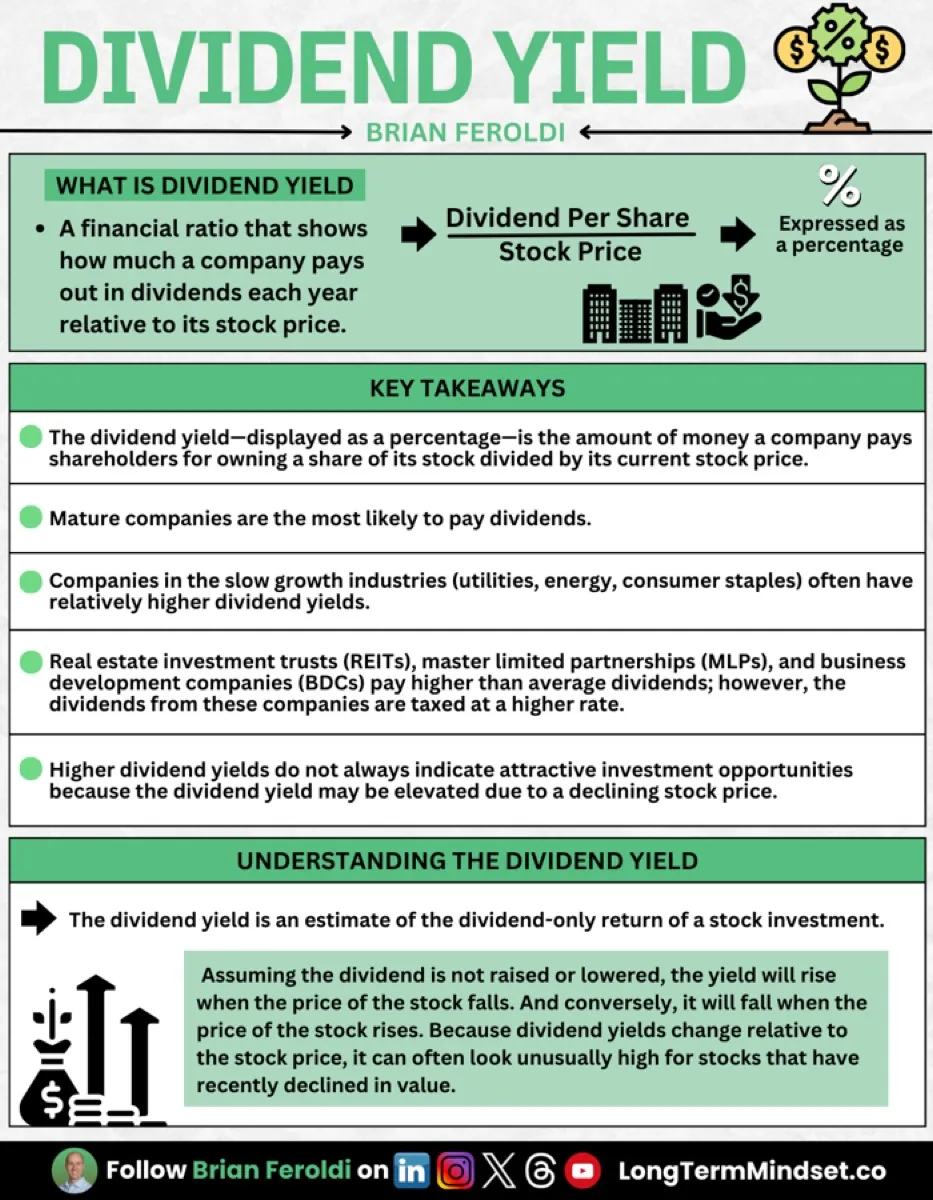
Dividend yield on one page
The formula, which kinds of company tend to carry high yields, and the tax treatment that makes some of those yields smaller than they look.
A dividend is a phase-four signal
Companies pay dividends when growth has slowed enough that reinvesting everything no longer pays. Phase Check confirms whether a payer is genuinely in capital return or has slipped into decline, which is when payout ratios stop meaning what they usually mean.
Try Phase Check freeNo credit card. One check without an account, unlimited with a free one.
Frequently asked questions
Related
- Dividend Safety Score, check whether a high yield is safe
- Is a dividend safe?, the five checks that catch most cuts
- Free cash flow, what a dividend actually has to be paid from
- The 5 lifecycle phases, why dividends belong to phase four
- Investing glossary, every term used above, defined in plain English