
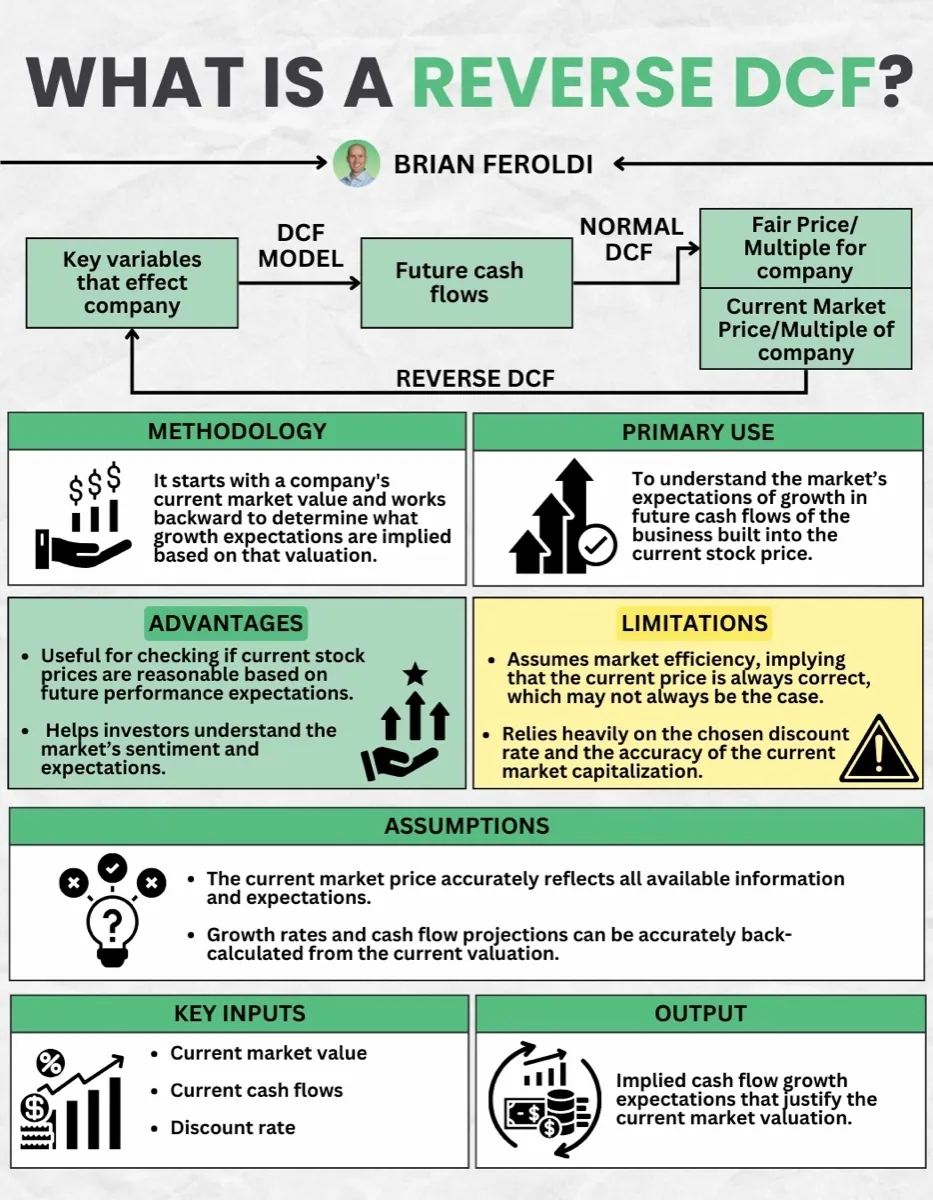
A reverse DCF is a discounted cash flow run backwards. Instead of estimating a fair value, you take the current share price and solve for the growth rate the market must already be expecting. It turns an unanswerable question, what is this worth, into a checkable one: are those expectations reasonable?
The problem it solves
A standard DCF asks you to forecast a decade of cash flows, pick a discount rate and choose a terminal growth rate, then produces a precise-looking number that swings wildly on small changes to any of those inputs. Move the terminal rate by one percentage point and the valuation can move thirty percent. The output inherits all the uncertainty of the inputs and hides it behind a decimal point.
The reverse DCF sidesteps this. Rather than asking you to predict the future, it reads the prediction already embedded in the price and hands it back to you as a single number: this is the growth rate that justifies what people are paying right now. You are no longer forecasting. You are judging someone else's forecast, which is a far easier task.
How it works
Take the current market capitalisation, the current free cash flow, and a discount rate reflecting the return you require. Then solve for the growth rate that makes the discounted future cash flows equal today's price. Any spreadsheet or valuation tool will do the arithmetic.
Worked example
A company trades at 30 times free cash flow. You require a 10% return, and you assume growth settles to 3% a year after the first decade.
Question a normal DCF asks: what is this worth?
Question the reverse DCF asks: what must free cash flow do
over the next ten years for 30× to make sense at a 10% return?
The answer comes back as a growth rate, say roughly 12% a year. Now the judgement is concrete: has this company grown at 12% before, does it have the market and the moat to do it for another decade, and what happens to my return if it manages 7% instead? Those are questions you can actually answer.
Why it changes the conversation
Most valuation arguments are unresolvable because both sides are asserting forecasts. A reverse DCF replaces the argument with a fact about the price plus a judgement about plausibility. "This stock is expensive" is an opinion. "This price requires 25% growth for ten years, and only a handful of companies in history have done that" is an observation followed by a much narrower judgement.
It also catches the opposite case. A price implying 2% growth for a business that has compounded at 8% for a decade is the setup value investors look for, and the reverse DCF makes it visible without requiring you to be confident about the exact fair value.
Where it breaks
- It assumes the current price means something. The implied growth rate is only interesting if the market is roughly rational. During a mania or a panic it will tell you the market expects something absurd, which is true and not actionable on its own.
- It is sensitive to the discount rate. Change your required return from 8% to 12% and the implied growth rate moves substantially. Run a range rather than a point.
- It needs a stable cash flow base. A company with negative or erratic free cash flow gives you nothing to solve from, which rules out most of startup and hyper growth.
- It says nothing about quality. A reasonable implied growth rate for a business with a collapsing moat is not a buy signal. Valuation comes last for a reason.
The two directions on one page
A normal DCF runs left to right, from assumptions to a price. A reverse DCF runs right to left, from the price back to the assumptions it contains. Same machinery, opposite question.
Run a reverse DCF without building the model
Reverse DCF is one of the valuation tools inside Stock Simplifier Pro, alongside DCF and TAM analysis. Start with a free account to see where a company sits in its lifecycle first, which is what decides whether a reverse DCF will give you a usable answer at all.
Start with a free accountNo credit card. One check without an account, unlimited with a free one.
Frequently asked questions
Related
- Reverse DCF calculator, run one on any company in your browser
- Intrinsic value, the number a reverse DCF avoids having to estimate
- Free cash flow, the input the whole calculation runs on
- The 5 lifecycle phases, which valuation method fits which phase
- How to analyze a stock, valuation is step seven, and last for a reason