
There are four legitimate reasons to sell a stock: the thesis that made you buy it has changed, your own priorities have changed, the tax treatment favours selling now, or you cannot hold the position calmly. A falling price is not on the list. Nearly every regretted sale comes from treating it as though it were.
The four reasons
The thesis changed
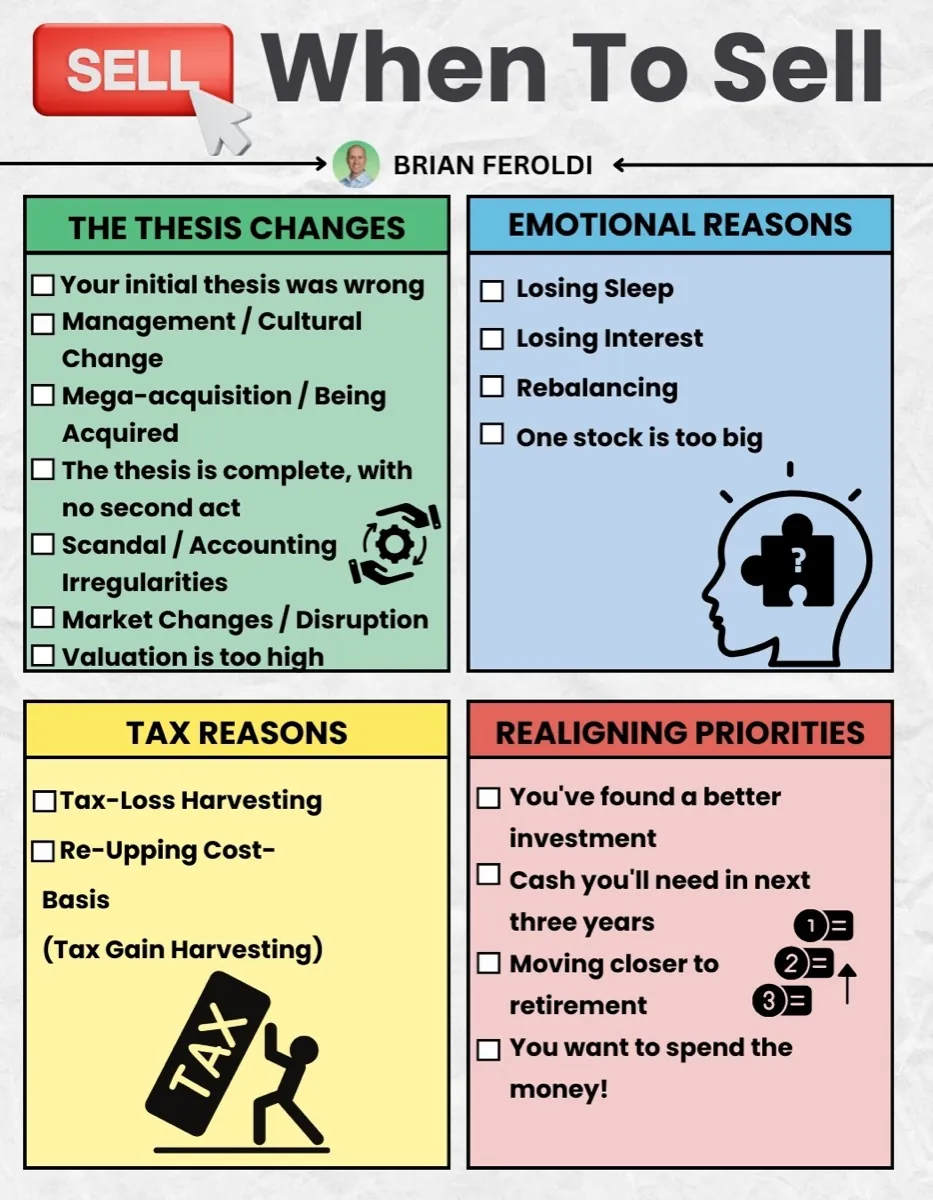
This is the only category where the company itself has given you new information, and it is the strongest reason to sell. It covers seven situations: the original thesis turned out to be wrong; management or the culture changed materially; a mega-acquisition altered the business you actually bought, or the company is being acquired; the thesis played out in full with no second act; a scandal or accounting irregularity appeared; the market shifted or a disruptor arrived; or the valuation reached a level no plausible future justifies.
The test: name the sentence in your original thesis that is now false. If you can, the thesis changed. If you cannot, the price changed, which is a different thing entirely.
Your priorities changed
These reasons are about you rather than the company, and they are legitimate. You found a genuinely better investment. You will need the cash within the next three years. You are moving closer to retirement and want less volatility. You want to spend the money, which is what the money was for.
Investors often ignore this category, because selling a good company feels like admitting a mistake. It is not. A position that no longer fits the life you are funding should be sold regardless of how good the business underneath it is.
The tax treatment favours it
Two mechanical cases. Tax-loss harvesting means selling a losing position to offset gains realised elsewhere, while keeping similar market exposure through a different holding. Tax-gain harvesting means realising a gain deliberately in a low-income year to reset the cost basis higher, so a later sale is taxed less.
Both should follow from your tax situation rather than a view on the company, and wash-sale rules restrict repurchasing a substantially identical security within 30 days. Check the mechanics, or check with someone who knows them, before acting.
You cannot hold it calmly
Losing sleep. Losing interest in following the company. Wanting to rebalance. Holding a position that has grown uncomfortably large. None of these are analytically rigorous and all of them are still worth acting on, because a portfolio you cannot hold through a bad year is a portfolio you will sell at the bottom of one.
The distinction that matters: trimming because a position has become too large a share of your portfolio is prudent risk management. Selling because it fell 30% this month is the single most reliable way investors convert a temporary decline into a permanent loss.
The full checklist
Every situation in the four categories, on one page. Most sell decisions that hold up later map onto one of these boxes, and most that do not hold up map onto none of them.
The reasons that do not hold up
- The price fell. A falling price is information about the market, not about the business. Unless it changed something in your thesis, it is noise wearing the costume of news.
- It is up a lot. Winners tend to keep winning. Selling them to lock in a gain is how most investors cap their own returns, then spend a decade watching the position they sold.
- It has gone nowhere for a year. Twelve months is a holding period for a trade. It is not a holding period for a business.
- You plan to buy it back lower. This requires being right twice, and the tax bill on the first sale means you have to be more than right to break even.
- Someone confident said so. A recommendation you did not derive is one you cannot evaluate when it stops working.
What makes this decision easier
Every reason above depends on comparing the company now against what you believed when you bought it. If that belief was never written down, there is nothing to compare against, so every price drop arrives feeling like new information. That is the mechanism by which people sell good companies at the bottom and hold broken ones to zero.
Write the thesis at purchase. Three or four sentences: what the company does, why it wins, what has to stay true, and what would prove you wrong. Reread it before every sell decision. It takes ten minutes once and it settles most of these questions before they become emotional.
A phase change is a thesis change you can check
The clearest version of a broken thesis is a company that has moved phase since you bought it, from hyper growth into operating leverage, or from capital return into decline. Phase Check tells you where any company sits today, so you can compare it against where it sat when you bought.
Check a stock you ownNo credit card. One check without an account, unlimited with a free one.
Frequently asked questions
Related
- How to analyze a stock, the framework that produces the thesis you check against
- The 5 phases of a company lifecycle, a phase change is one of the clearest thesis changes there is
- How to tell if a dividend is safe, five checks that catch most cuts before they happen
- Investing glossary, plain-English definitions of every term used above