
Most people analyse stocks backwards. They start with the price, decide whether it looks cheap, then work out whether the business deserves owning. Do it in that order and valuation drives the thesis instead of testing it. These seven questions work in sequence, and each one changes how you answer the next.
The steps
Understand how the business makes money
Before any ratio, answer in one sentence what the company sells, to whom, and how it gets paid. Then check the revenue split by segment and by geography. If you cannot explain the business simply, no amount of financial analysis will rescue the decision.
Identify its lifecycle phase
Companies move through five phases: startup, hyper growth, operating leverage, capital return and decline. The metrics that matter change completely at each one. Judging a hyper-growth company on profitability, or a capital-return company on revenue growth, is the single most common analytical error. Establish the phase before you judge any number.
Test whether the moat is real
Ask why a well-funded competitor cannot take these customers. Look for network effects, switching costs, cost advantages, intangibles or efficient scale. Then check the evidence: stable or expanding gross margins through cost inflation is the clearest sign pricing power actually exists.
Judge management and capital allocation
Read what management said three years ago and compare it to what happened. Check insider ownership, how they spend free cash flow, and whether share count is rising. Skilled operators who allocate capital badly still destroy value.
Examine growth and profitability together
Growth without returns consumes cash; returns without growth stagnate. Look at revenue growth alongside ROIC, and check whether margins expand as the company scales. Operating leverage that works in your favour is one of the strongest signals in investing.
Find what could break the thesis
List the three things that would make you wrong: customer concentration, debt with weak interest coverage, regulatory exposure, technology shift, dilution. Writing them down now is what lets you tell a broken thesis from a falling price later.
Value it, and check your assumptions
Use several methods rather than one. Trailing multiples for context, a discounted cash flow for rigour, and a reverse DCF to see what growth the current price already assumes. That last one converts an unanswerable question into a checkable one: are those expectations reasonable?
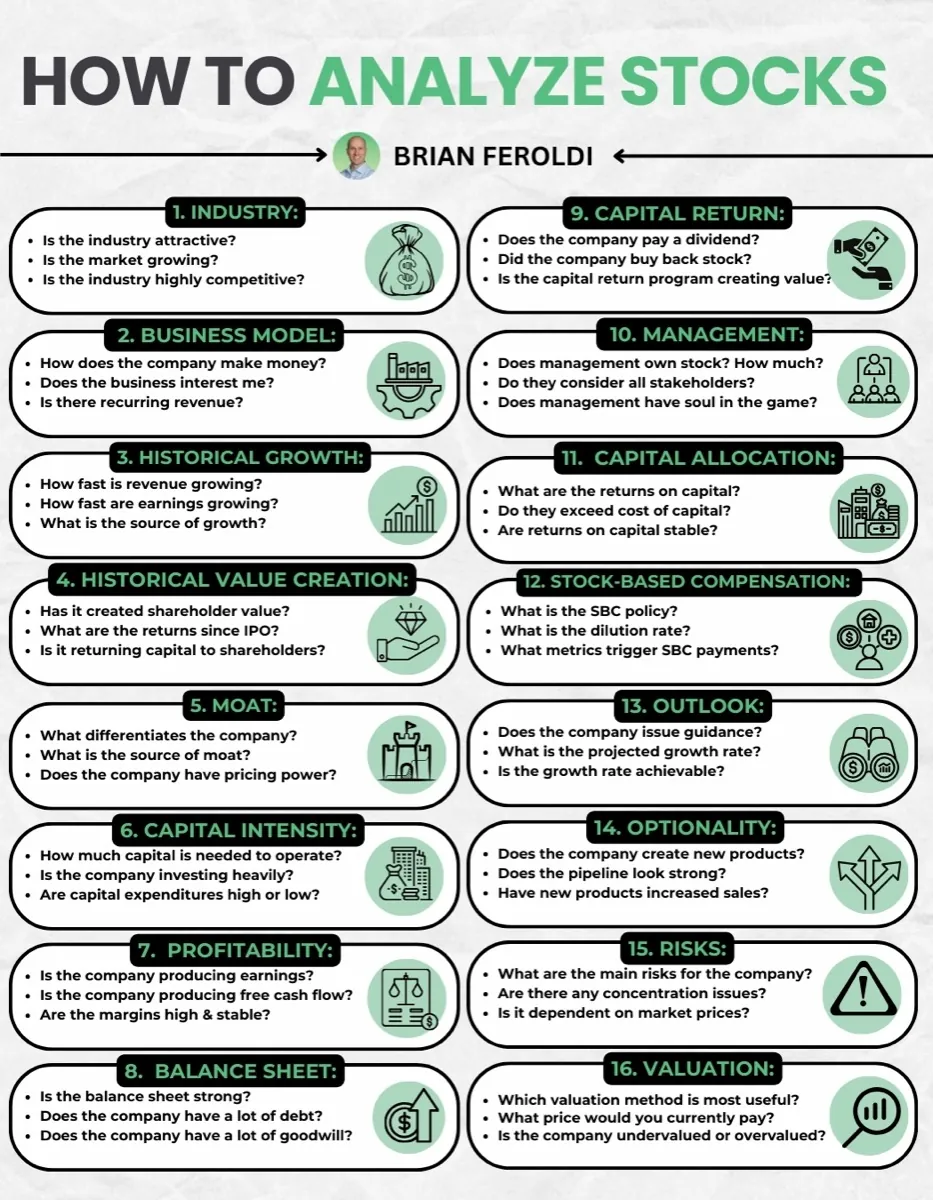
The 48-question checklist
The seven steps above are the sequence. This is the detail underneath them: sixteen categories with three questions each, the checklist this framework grew out of. Save it, or work through it the long way once before letting anything automate it for you.
Skip to the answer on step two
Step two asks which lifecycle phase the company is in, and it is the step that changes how you read every number after it. Phase Check answers it for any of 10,000+ global stocks in seconds, then names the metric that matters most at that phase.
Try Phase Check freeNo credit card. One check without an account, unlimited with a free one.
Frequently asked questions
Related
- Investing glossary, plain-English definitions of every term used above
- Compare 25 research tools, honest guides to what each one does well
- The 5 phases of a company lifecycle, step two in full, and why the phase decides which metrics matter
- How to read an income statement, the five numbers behind steps one and five
- When to sell a stock, what to do with the thesis once you have written it down