
Return on equity measures the profit a company generates for every dollar of shareholder equity. It is net income divided by shareholders' equity. It answers how hard the owners' money is working, and it can be raised substantially without the business improving at all.
Why it is the most gameable ratio in finance
Equity sits in the denominator, so anything that shrinks equity raises ROE. A company can borrow money and buy back stock, which reduces equity while barely touching net income. The ratio jumps. Nothing about the operations changed, and the business is now riskier than it was.
This is not an abuse so much as the arithmetic working as designed, which is exactly why ROE on its own should never be treated as a measure of quality.
Worked example
A company earns $100M on $1,000M of equity. It then borrows $400M and buys back stock, and interest costs reduce net income to $88M.
Before: $100M ÷ $1,000M = 10.0%
After: $88M ÷ $600M = 14.7%
ROE rose almost five points while profit fell. Any investor screening on ROE alone would read this as a substantially better company.
The three components
DuPont analysis splits ROE into net margin, asset turnover and financial leverage, which is the fastest way to see where a number is coming from. Two companies reporting 20% can be completely different: one earning it through margin and efficiency, another through borrowing.
The question to carry into any high ROE is which of the three is doing the work. If it is leverage, you are being paid for risk rather than for quality.
What counts as good
Above 15% sustained is generally strong, and above 20% is excellent if it comes from operations rather than leverage. Below the cost of equity, usually around 8% to 10%, the company is not earning what its owners require.
Negative equity makes the ratio meaningless rather than infinite. Companies that have bought back stock aggressively for years can report negative book equity while remaining highly profitable, at which point ROE stops describing anything and ROIC is the only usable measure.
When to use ROE anyway
For banks and insurers it remains the standard, because leverage is the business rather than a financing choice, and the balance sheet is the product. For almost everything else, ROIC answers the same question without the distortion, since it places debt and equity together in the denominator.
The practical habit: read them side by side. A wide gap between a high ROE and a mediocre ROIC is a leverage story, and it will tell you more than either number alone.
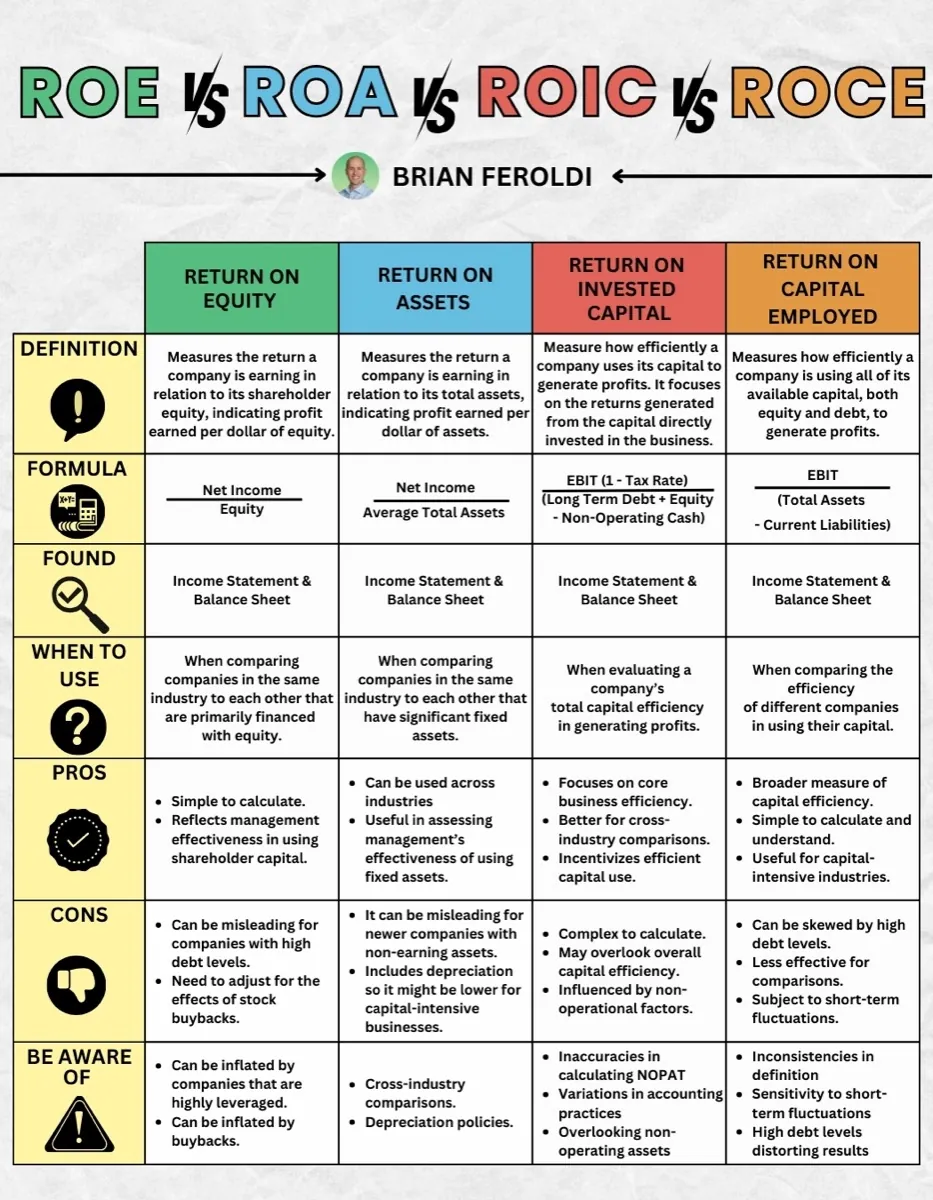
ROE against the three metrics it is confused with
Each formula, when it is the right tool, and what distorts it.
Read ROE next to the phase it sits in
A 25% ROE means one thing for a capital-return compounder and another for a leveraged business late in its life. Phase Check places any of 10,000+ global stocks on the lifecycle and names the metric that matters most where it sits.
Try Phase Check freeNo credit card. One check without an account, unlimited with a free one.
Frequently asked questions
Related
- ROIC, the same question without the leverage distortion
- How to read a balance sheet, where the equity figure comes from
- Gross margin, one of the three components behind a high ROE
- Investing glossary, every term used above, defined in plain English