
A stock split increases the number of shares outstanding and reduces the price per share proportionally. A shareholder ends up with more shares worth the same total, and the company is worth exactly what it was the day before. Nothing about the business changes.
What changes and what does not
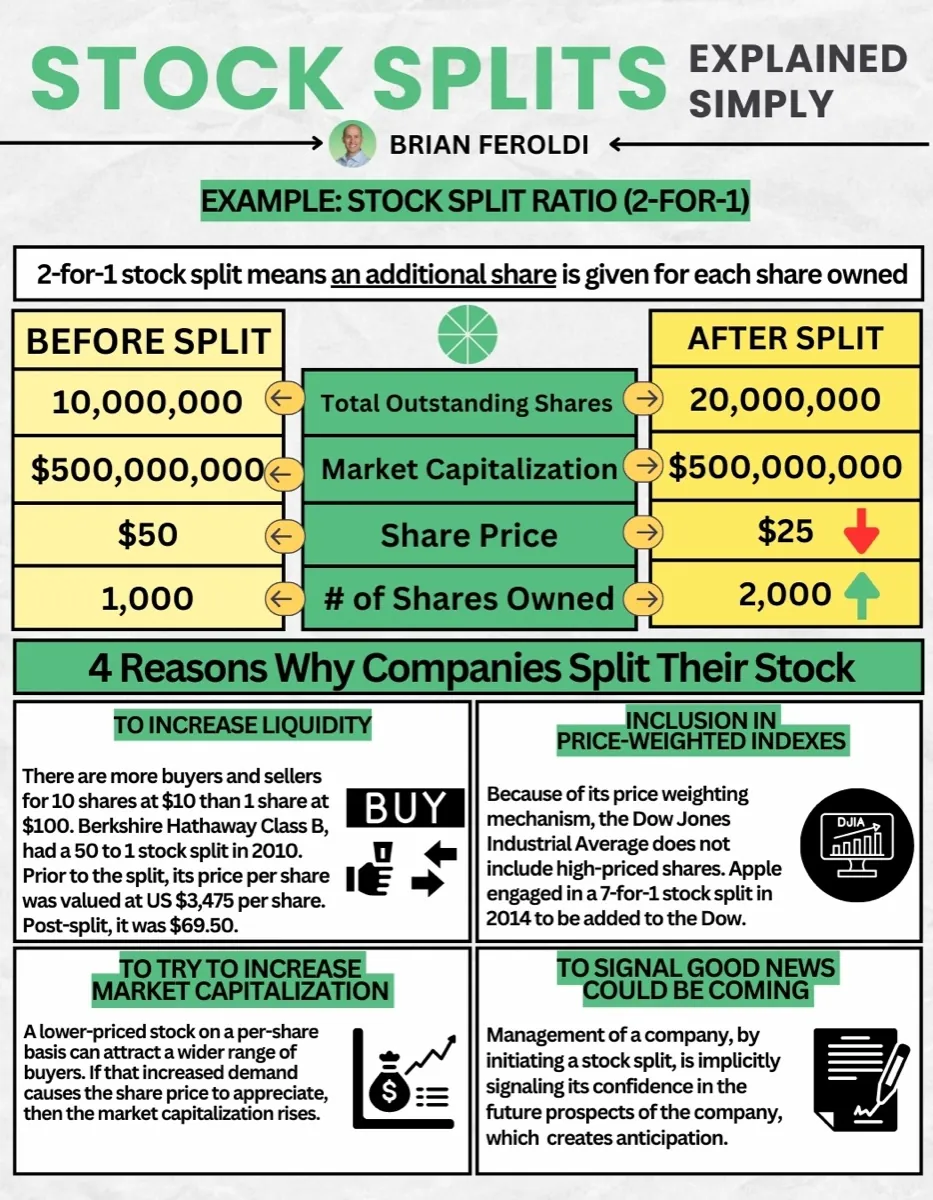
In a two-for-one split every holder receives one additional share for each one held. The share count doubles, the price halves, and every ratio built on per-share figures adjusts with it. Market capitalisation, revenue, profit, cash flow and your percentage ownership are all exactly where they were.
Worked example
A company with 10 million shares at $50 does a two-for-one split. You hold 1,000 shares.
Shares outstanding 10,000,000 → 20,000,000
Share price $50 → $25
Market capitalisation $500,000,000 → $500,000,000
Your shares 1,000 → 2,000
Your holding $50,000 → $50,000
Cutting a pizza into more slices does not produce more pizza. This is the whole of it.
Why companies do it anyway
- Liquidity. More buyers and sellers exist for ten shares at $10 than for one at $100. Berkshire Hathaway's Class B ran a fifty-to-one split in 2010, taking the price from about $3,475 to roughly $69.50.
- Index inclusion. The Dow Jones Industrial Average is price-weighted, so a very high-priced share distorts it. Apple's seven-for-one split in 2014 preceded its addition to the Dow.
- Reaching more buyers. Fractional shares have weakened this considerably, since a $3,000 share is now buyable in pieces at most brokers. The argument is much older than the fix.
- Signalling. Management rarely splits a share it expects to fall, so a split carries a mild implicit statement of confidence. It is a signal about management's belief, not about the business.
Why the price often rises anyway
Studies have found modest positive returns around split announcements, and the likeliest explanation is not the split. Companies split shares after the price has risen a long way, which happens to companies that have been performing well, and companies performing well often continue to. The split is a symptom of the run, not a cause of the next one.
Treating a split as a reason to buy is reasoning from a marker rather than from the business.
Reverse splits are a different animal
A reverse split does the opposite: fewer shares, higher price. One-for-ten turns ten $1 shares into one $10 share. The arithmetic is equally neutral and the context usually is not.
The common reason is an exchange listing requirement, since most exchanges delist below a minimum price. A company reverse-splitting to stay listed is telling you the market has been marking it down for a long time. It is not automatically a sell signal, and it is a strong prompt to check whether the underlying thesis is still true, and often a marker of a business in decline.
The before and after, and the four reasons
What each line on the balance of your holding does through a two-for-one split, and the four motives companies actually give, with real examples.
A split changes nothing. The phase changes everything.
Share count is arithmetic. Where a company sits in its lifecycle decides which metrics matter and how it should be valued. Phase Check reads the financials for any of 10,000+ global stocks and answers that in seconds.
Try Phase Check freeNo credit card. One check without an account, unlimited with a free one.
Frequently asked questions
Related
- P/E ratio, the ratio a split leaves completely unchanged
- The 5 lifecycle phases, what a reverse split often signals
- Investing glossary, every term used above, defined in plain English
- How to analyze a stock, what to look at instead of the share count