
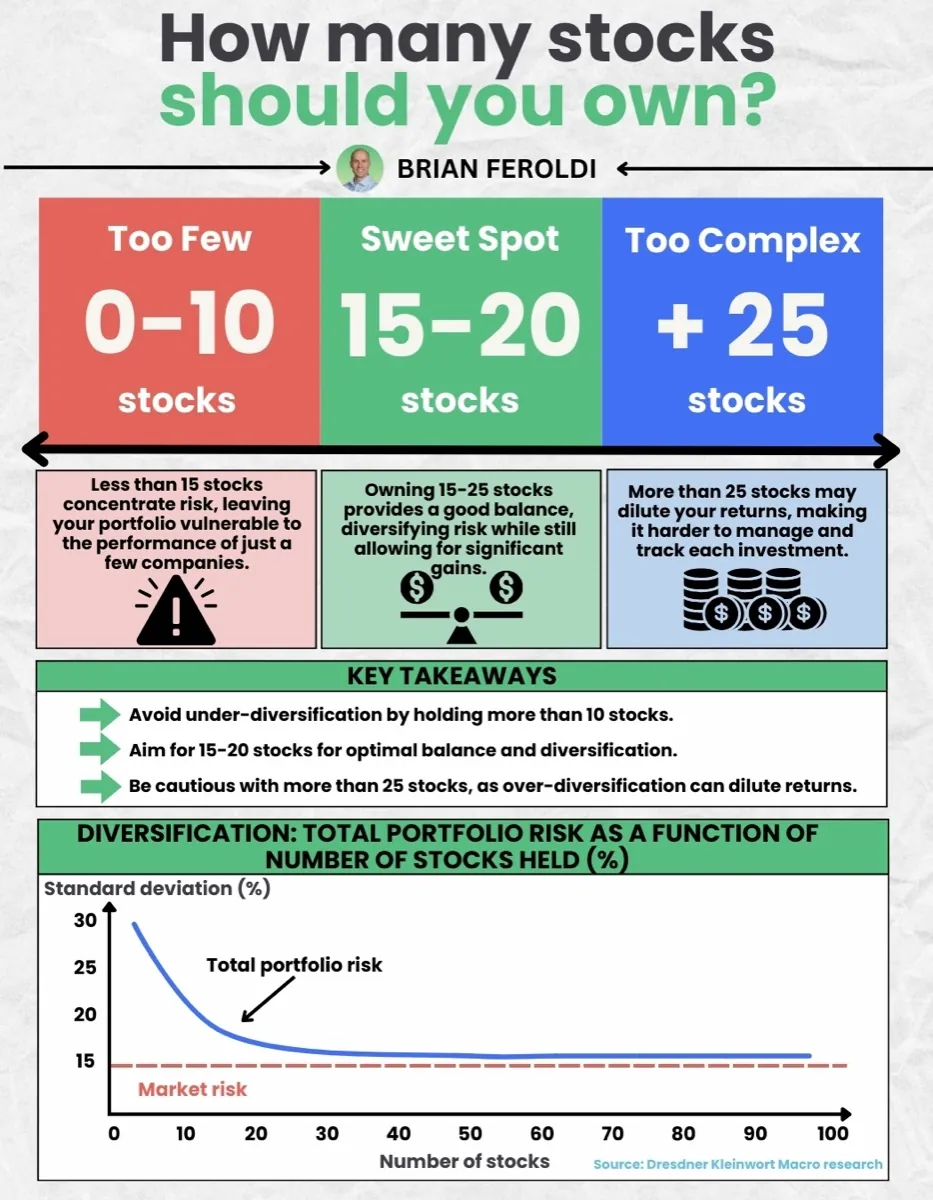
Most research points to 15 to 25 individual stocks as the practical range. Below roughly 10, a single company can dominate your outcome. Above roughly 25, additional positions remove very little further risk while making the portfolio harder to follow properly, which quietly raises a different risk.
What diversification actually removes
Portfolio risk splits in two. Company-specific risk is the risk that one business fails: an accounting scandal, a failed drug trial, a disrupted product. Market risk is the risk that everything falls together, and no amount of stock picking removes it.
Diversification only addresses the first kind, and it does so with sharply diminishing returns. Moving from one stock to ten removes most of the company-specific risk. Moving from ten to twenty removes a good deal of what is left. Moving from twenty to a hundred barely moves the line at all, because what remains is market risk, which is not going anywhere.
That curve is the whole argument. The benefit is nearly exhausted by around twenty holdings, so positions beyond that are paying a real cost in attention for almost no reduction in risk.
The cost nobody counts
Every position needs maintaining. Earnings read four times a year, a thesis checked, a competitive position reassessed. Call it a few hours a year each if you are being honest about it.
Forty positions is therefore a part-time job, and the realistic outcome is not that you do it. It is that you follow eight of them properly and hold the other thirty-two on the strength of a decision you made years ago and have not revisited. That is worse than owning eight, because you have the illusion of diversification and none of the understanding, and you will not notice when one of the thirty-two breaks.
The two limits that decide your number
- How many businesses can you genuinely follow? This is a hard constraint set by your time, not a preference. If the answer is twelve, owning twenty-five means owning thirteen you do not understand.
- How large a single loss can you survive, financially and emotionally? At twenty equal positions, a total loss on one costs 5%, which is recoverable and survivable. At five positions it costs 20%, which for most people is the point at which the rest of the portfolio starts getting sold too.
Take the lower of the two answers. Concentration only works if the concentrated positions are genuinely better understood than the alternatives, and the honest test is whether you can explain each thesis without looking anything up.
Position sizing matters more than the count
Twenty stocks where one is 40% of the portfolio is a concentrated portfolio wearing a diversified costume. The number of holdings tells you very little on its own; what matters is how much of your outcome depends on any single one.
The other half of that question is correlation. Twenty positions that are all high-growth software companies will move together in a downturn, so the count says twenty and the exposure says roughly one. Spread across lifecycle phases and industries, twenty positions behave much more like twenty.
If you cannot follow any of them
The honest answer for many people is that they do not want to spend a weekend a year per company, and for them the right number of individual stocks is zero. An index fund delivers market returns for no research at all, and beats a portfolio of forty half-followed positions comfortably. Owning individual stocks is a choice to do work, and it only pays if the work happens.
The diversification curve, and where it flattens
The three bands, and underneath them the research chart that explains why: total portfolio risk falls steeply to about twenty holdings and then runs almost flat along the market-risk floor.
Understand each position well enough to keep it
The real limit on portfolio size is how many businesses you can genuinely follow. Phase Check tells you where any of 10,000+ global stocks sits in its lifecycle and what to watch there, which is the fastest way to keep a thesis current on the ones you already own.
Try Phase Check freeNo credit card. One check without an account, unlimited with a free one.
Frequently asked questions
Related
- When to sell a stock, what to do when a position stops fitting
- How to analyze a stock, the work each position requires
- The 5 lifecycle phases, spreading exposure across phases, not just names
- Investing glossary, every term used above, defined in plain English