
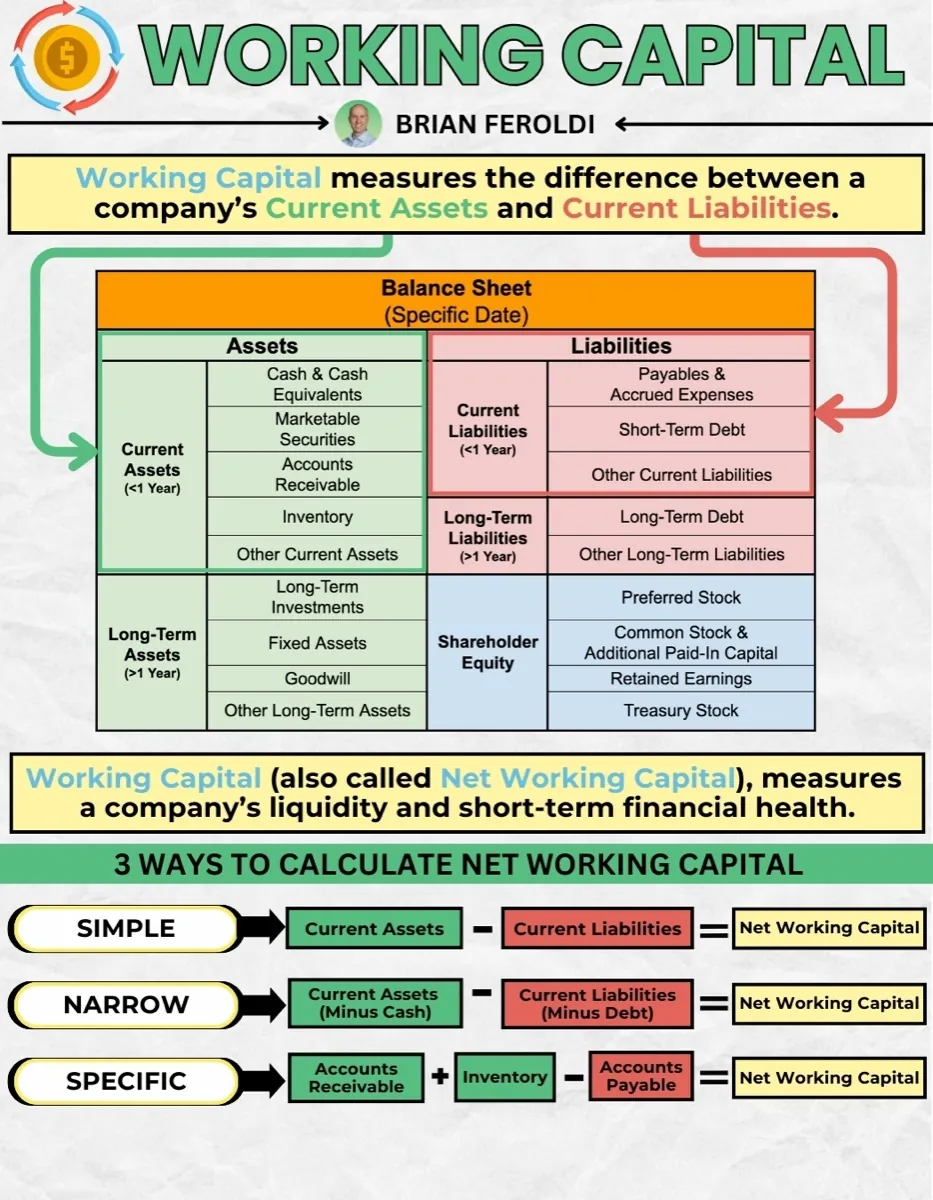
Working capital is the difference between a company's current assets and its current liabilities: what it owns that will convert to cash within a year, minus what it owes within a year. It measures short-term liquidity, and its direction over time says as much about the business as its level.
Three ways to calculate it
The simple version subtracts all current liabilities from all current assets. It is the standard definition and it mixes two different things: how the business operates, and how it is financed.
The narrow version strips out cash on the asset side and short-term debt on the liability side, which isolates the operating position from financing decisions. The specific version goes further still, keeping only the three lines that actually move with trading: accounts receivable plus inventory, minus accounts payable. That last one is what most analysts mean when they talk about working capital changing.
Worked example
A company holds $400M of cash, $300M of receivables and $250M of inventory, against $180M of payables, $120M of short-term debt and $100M of other current liabilities.
Simple: $950M − $400M = $550M
Narrow: $550M − $280M = $270M
Specific: ($300M + $250M) − $180M = $370M
Three defensible numbers for the same balance sheet. Pick one and use it consistently, because the comparison across years is where the information lives.
Why the direction matters more than the level
Working capital that grows faster than revenue is one of the quieter warning signs in financial analysis. It usually means receivables are ageing, because customers are paying more slowly or the company is selling to weaker ones, or inventory is building, because the product is moving less easily than forecast.
Both consume cash without appearing on the income statement. This is exactly how a company reports rising profits while its bank balance falls, and it is why the cash flow statement catches deterioration that the income statement hides.
Negative working capital is often excellent
The textbook reading is that negative working capital signals distress. For a large group of businesses it signals the opposite: enormous negotiating power.
A supermarket sells stock for cash in days and pays suppliers in weeks. A subscription business collects a year upfront and delivers monthly. In both cases the customer and the supplier are funding the operation, which means growth generates cash instead of consuming it. Negative working capital from that source is one of the strongest structural advantages a company can have.
The distinction is where the negative number comes from. Deferred revenue and stretched payables backed by real leverage are a strength. Payables stretched because the company cannot pay are a symptom.
What to actually check
- Working capital as a percentage of revenue, over five years. Stable or falling is good. Rising needs an explanation.
- Days sales outstanding. Receivables divided by daily revenue. A rising figure means the company is collecting more slowly.
- Days inventory outstanding. A rising figure means goods are sitting longer, which often precedes a write-down.
- The cash flow statement's working capital line. It shows directly how much cash the change consumed or released this year, which is the number that ultimately matters.
Where working capital sits on the balance sheet
Which lines count as current, which do not, and the three calculations laid out side by side so the difference between them is visible.
See the balance sheet in the context of the phase
Working capital building during hyper growth usually means the company is stocking up for demand. The same build during decline usually means the demand did not arrive. Phase Check places any of 10,000+ global stocks on the lifecycle so you know which reading applies.
Try Phase Check freeNo credit card. One check without an account, unlimited with a free one.
Frequently asked questions
Related
- How to read a cash flow statement, where the working capital change appears
- Free cash flow, what working capital swings ultimately move
- How to analyze a stock, the seven-step framework this sits inside
- Investing glossary, every term used above, defined in plain English