
A network effect is a competitive advantage where each additional user makes the product more valuable to every other user. Marketplaces, payment networks and social platforms are the classic examples. Network effects are powerful because they strengthen as the company grows, making late entrants progressively less able to compete on product alone.
Why it beats every other moat
Most competitive advantages erode. A cost advantage invites a competitor to build a bigger factory. A patent expires. A brand can be out-marketed. Each of these has to be defended, and defending costs money.
A network effect works the other way. Every new user does the defending for you, because the product a competitor has to beat is not the one you built, it is the one your users collectively created. That is why a challenger with a better interface and unlimited funding still loses: the interface is not what people are there for.
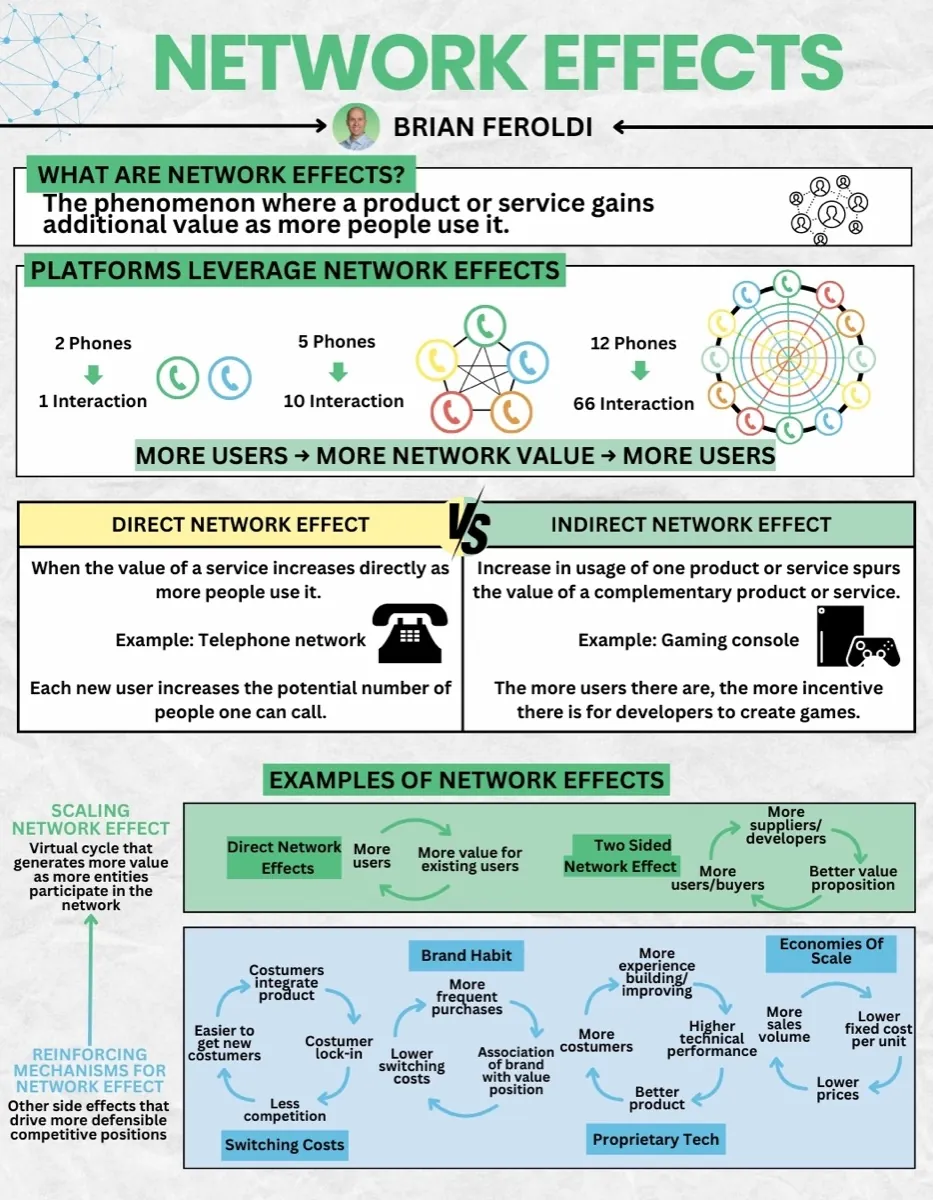
The arithmetic is unforgiving for late entrants. Two phones on a network allow one connection. Five allow ten. Twelve allow sixty-six. Value grows roughly with the square of participants while cost grows linearly, so the gap between the leader and the challenger widens even if both add users at the same rate.
Direct and indirect
Direct network effects raise value as users of the same kind join. A telephone network, a messaging app, a social platform. Each new user is directly reachable by every existing one.
Indirect network effects run through a complementary group. More people buy a games console, so more developers build for it, so the console becomes more attractive, so more people buy it. Marketplaces work the same way: buyers attract sellers, sellers attract buyers.
The distinction matters because indirect effects are slower to start and harder to break once running. A competitor has to solve both sides at once, which is the reason marketplace incumbents are so durable.
How to tell a real one from a story
Every consumer platform claims a network effect. Very few have one. The test is whether the product genuinely improves for existing users when new ones arrive, or whether the company just gets bigger.
- Does user growth improve the product for people already there? A food delivery app with more restaurants, yes. A subscription news site with more subscribers, no. More readers do not make the articles better.
- Do customers spend more each year without being sold to? Net revenue retention above 100% is the network effect showing up in a financial statement.
- Has a well-funded competitor tried and failed? The most persuasive evidence available, and it is a matter of record rather than opinion.
- Are the effects local or global? A ride-hailing network is strong in one city and worth nothing in the next, which is why those businesses are attacked city by city and why their economics look nothing like a global platform's.
How they break
Network effects are the strongest moat, not an indestructible one. Multi-homing kills them quietly: when users can belong to several networks at once at no cost, as with food delivery apps or freelance marketplaces, the advantage never consolidates. A platform can also squeeze its own network by raising take rates until one side leaves. And a shift in how people use the category, rather than a better competitor, can leave a strong network attached to something nobody wants.
So the annual question is not whether the network is large but whether it is denser and more exclusive than last year.
Network effects on one page
The definition, the arithmetic of why value compounds, direct against indirect with worked examples, and the reinforcing mechanisms that turn a network effect into several moats at once.
Check whether the network is actually producing returns
A network effect should show up as a high and rising return on capital, and as a company that has moved from burning cash into operating leverage. Phase Check reads the financials for any of 10,000+ global stocks and places it on the lifecycle curve.
Try Phase Check freeNo credit card. One check without an account, unlimited with a free one.
Frequently asked questions
Related
- Economic moat, the five types, and how network effects rank
- Switching costs, the moat that most often reinforces a network
- ROIC, where a real network effect eventually shows up
- Investing glossary, every term used above, defined in plain English