
Switching costs are the money, time, risk or disruption a customer absorbs to move to a competitor. High switching costs let a company raise prices without losing customers, because leaving is more expensive than paying more. Enterprise software and banking relationships are the typical examples.
The advantage that does not need a better product
Most competitive advantages require being better at something. Switching costs do not. They require only that leaving is painful, which is why companies with mediocre products and furious customers can still earn excellent returns for decades.
This makes them one of the most reliable moats to underwrite, because you are not betting on continued excellence. You are betting on inertia, and inertia is more predictable than innovation.
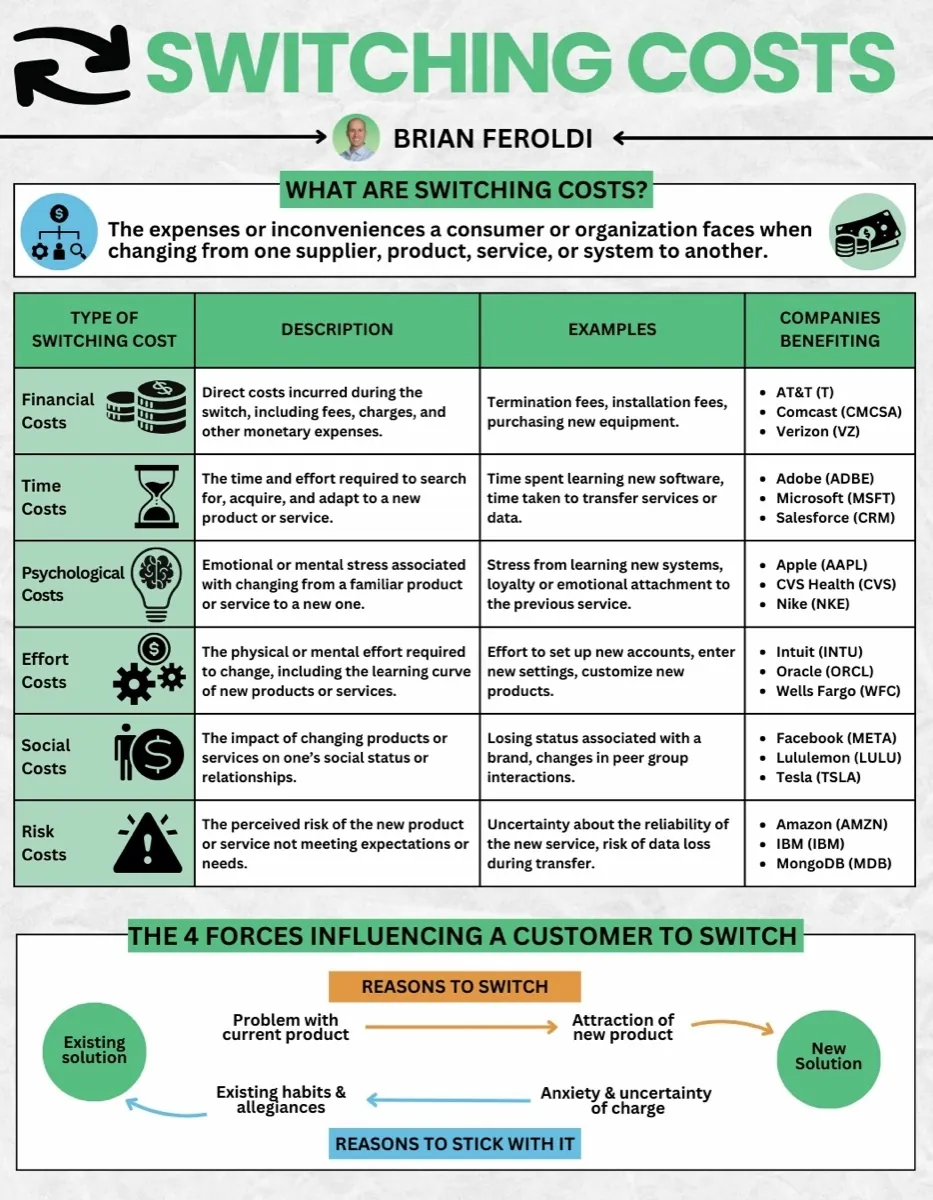
The six types
- Financial. Termination fees, installation charges, new equipment. The most visible and usually the weakest, because a competitor can simply pay them on the customer's behalf.
- Time. Learning a new system, migrating data, retraining staff. Often the largest cost and the one least visible on any invoice.
- Effort. Reconfiguring, rebuilding integrations, re-establishing workflows. Distinct from time because it falls on the person making the decision, which is why it weighs so heavily.
- Risk. The new system might not work. Data might be lost. For anything mission-critical this dominates every other consideration, and it is why incumbents in banking and healthcare software are so hard to displace.
- Psychological. Familiarity, habit, attachment to a brand or an interface. Real, and routinely underestimated by analysts who assume customers behave rationally.
- Social. Status attached to a product, or a peer group organised around it. Weakest individually and powerful when it reinforces the others.
How to see them in the numbers
Switching costs are asserted constantly and shown rarely. Three places they become visible:
- Net revenue retention. Above 100% means existing customers spend more each year without being replaced. Above 120% is exceptional and very difficult to achieve without genuine lock-in.
- Price increases that stick. A company that raised prices and did not lose volume has demonstrated switching costs. Look at gross margin through a period of inflation.
- Customer lifespan. Average tenure measured in many years, and low churn that stays low as the customer base grows, rather than only while it is small.
What weakens them
Every switching cost has a competitor working on lowering it. Data portability regulation dismantles financial and effort costs. Migration tooling built specifically to import from the incumbent attacks time costs. Cloud delivery removed much of the risk cost that once protected on-premise software. And a generational change in who makes the buying decision can erase psychological costs overnight, because the new decision-maker never formed the habit.
The most dangerous version is a company that has stopped investing because it believes its customers cannot leave. Switching costs buy time, not permanence, and the companies that lose them usually spend that time badly.
The six types, with companies that benefit from each
Each type of switching cost, what it looks like in practice, an example, and public companies whose economics depend on it. Plus the four forces pulling a customer toward switching and back again.
See whether the lock-in is showing up in the financials
Switching costs should produce stable margins, low churn and a high return on capital. Phase Check reads the financials of any of 10,000+ global stocks, places it on the lifecycle, and names the metric worth watching at that phase.
Try Phase Check freeNo credit card. One check without an account, unlimited with a free one.
Frequently asked questions
Related
- Economic moat, where switching costs sit among the five types
- Network effect, the moat switching costs most often reinforce
- Gross margin, where pricing power becomes visible
- Investing glossary, every term used above, defined in plain English