
Business warning signs are changes that suggest a company's position is weakening before the financial statements show it. Most are yellow flags rather than red: reasons to investigate and reassess the thesis, not reasons to sell on their own.
Yellow, not red
The distinction matters more than the list. A single warning sign is a prompt to check whether the reason you own the company is still true. Two or three arriving together, or one that directly contradicts your thesis, is a different matter.
Selling on any single signal will cost you more good companies than it saves you from bad ones, because every business has a difficult year. The value of a checklist is that it makes you look rather than that it makes you act.
The six
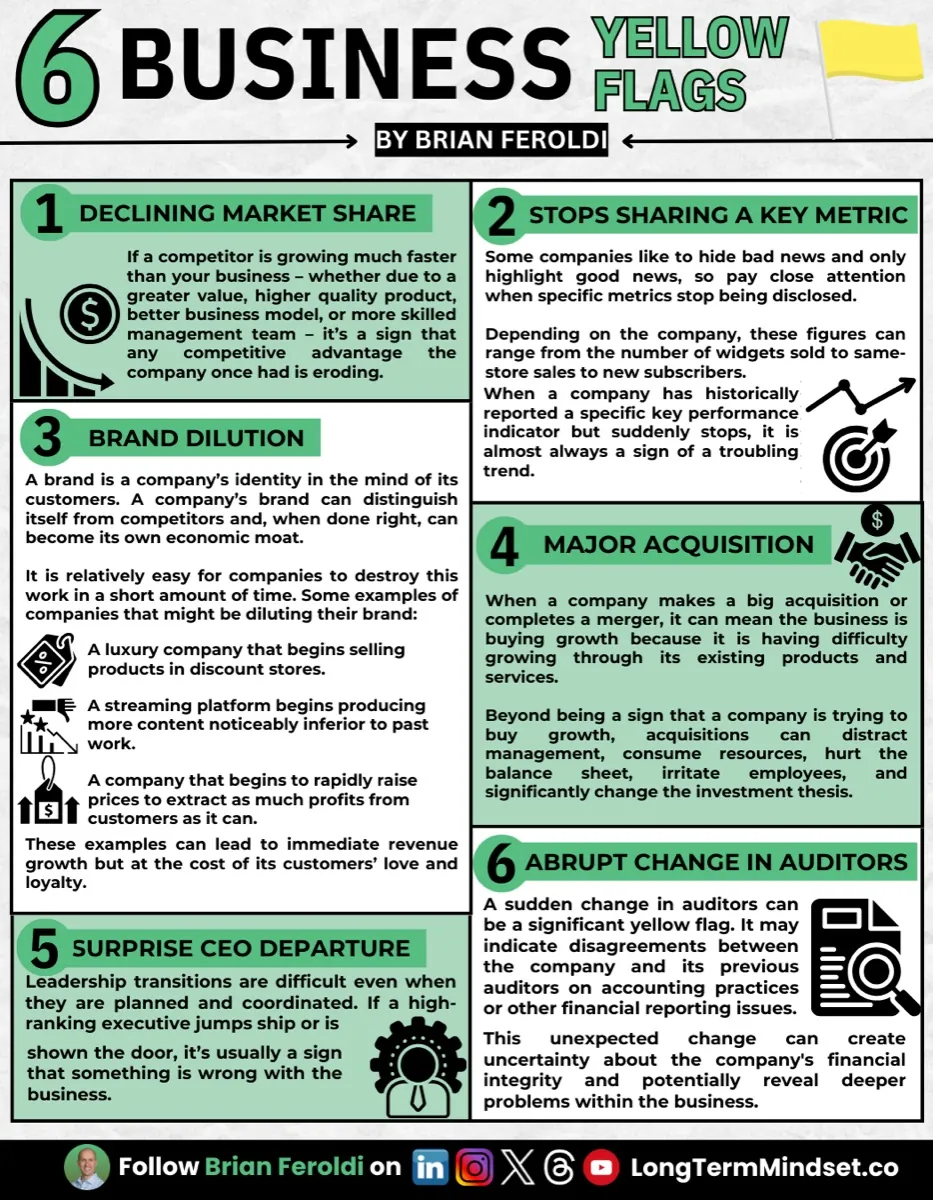
- Declining market share. If a competitor is growing faster, whether on price, quality or execution, the advantage the company once had is eroding. Revenue can still rise while share falls, which is why this one hides in a growing business.
- A metric stops being disclosed. The most reliable signal on this list. Companies report what flatters them, so when a figure they have highlighted for years quietly disappears from the deck, the trend in it has turned. Same-store sales, subscriber counts and units shipped are the usual casualties.
- Brand dilution. A luxury name appearing in discount stores, a streaming service producing visibly cheaper content, a company raising prices faster than the value it adds. Each buys revenue now against customer loyalty later.
- A major acquisition. Often a company buying growth because organic growth has become difficult. Beyond that signal, acquisitions distract management, consume the balance sheet and can change the business you thought you owned.
- A surprise CEO departure. Planned transitions are hard enough. An abrupt exit, particularly without a named successor, usually means something the outside does not yet know.
- An abrupt auditor change. Rare and serious. It can indicate disagreement over accounting treatment, and at minimum it introduces uncertainty about financial reporting that takes years to settle.
What to do when one appears
Go back to what you wrote when you bought. If the signal contradicts a specific claim in that thesis, the thesis has changed and that is one of the four real reasons to sell. If it does not, note it, set a date to check again, and carry on.
The failure mode in both directions is symmetrical. Ignoring signals because you like the company is how people ride a business to zero. Selling on the first one is how they never hold anything long enough to compound.
The six on one page
Each signal, what it usually means, and the examples that make it recognisable.
Check whether the phase changed too
The most consequential warning sign is not on this list: a company that has moved from one lifecycle phase to another since you bought it. Phase Check tells you where any of 10,000+ global stocks sits today.
Try Phase Check freeNo credit card. One check without an account, unlimited with a free one.
Frequently asked questions
Related
- When to sell a stock, the four reasons that hold up
- Economic moat, what these signals suggest is eroding
- How to read a 10-K, where several of these first appear
- How to analyze a stock, the framework to reassess against